Welcome to our Company

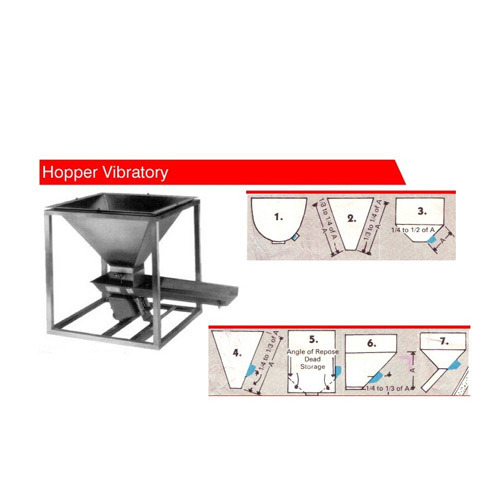
Hopper Vibratory
16000 INR/Unit
Product Details:
- Type Hopper Vibratory
- Material Stainless Steel
- Capacity 100 kg/hr
- Computerized No
- Automatic Grade Semi-Automatic
- Voltage 220 V
- Frequency (MHz) 50 Hz
- Click to View more
X
Hopper Vibratory Price And Quantity
- 01 Piece
- 16000 INR/Unit
Hopper Vibratory Product Specifications
- 1000 x 500 x 900 mm
- Customizable
- 50 Hz
- No
- 500 mm
- 85 kg
- 220 V
- Stainless Steel
- Hopper Vibratory
- Semi-Automatic
- 100 kg/hr
- Batch Feeding, Pharmaceutical, Food Processing
- Floor-mounted
- Adjustable
- Vibratory Feeding
- Low
- Polished
- Anti-rust Coating
- Up to 60C
- Vibratory Motor
- 0.75 kW
Hopper Vibratory Trade Information
- Cash Against Delivery (CAD), Telegraphic Transfer (T/T), Cash in Advance (CID)
- Per Week
- 01-02 Week
- Yes
- Contact us for information regarding our sample policy
- As per client requirement
- Australia, North America, Eastern Europe, South America, Western Europe, Africa, Central America, Middle East, Asia
- All India
Product Description
Hopper Vibratory
Features:
- Prevent labor from hammering or blasting the air inside
- Ideal equipment facing for problem of arching bridging and rat holing at the out let.
- Some cases it is replacement to rotary value.
- Lower power consumption
- Long life guaranteed for suspension and sleeve
Flour, soya meal, sugar pigments, starch, carbon black, foundry, sand, chips, saw dust, colorants, talc lime soda ash, coal, fly ash, cattle feed, spent grain.
Working Principal
This equipment consist of conical dish type plate which is welded to the body of the bin activator from inside. The half portion of bin activator vibrators horizontally with help of unbalanced vibratory motor which helps the material pushes it in all direction to come surface. The vibration will also get transmitted to the material in upper portion of the bin as the vibration takes place
Precision Batch Feeding
Optimize your operational flow with this hopper vibratory system tailored for batch feeding applications. Its adjustable vibration amplitude and vibratory feeding mode ensure consistent, accurate material delivery, minimizing product loss and enhancing process control in sensitive environments like pharmaceuticals and food processing.
Durability Meets Hygiene
Manufactured from polished stainless steel and treated with anti-rust coating, the hopper vibratory unit withstands rigorous industrial demands while maintaining hygiene. Suitable for batch operations requiring contamination control, its designed for easy cleaning and long service life.
Quiet and Efficient Operation
Engineered to produce low noise levels, this machine is suitable for settings where acoustic comfort is important. The robust vibratory motor provides reliable performance with minimal energy consumption, while the floor-mounted design assures stability and ease of access during operation or maintenance.
FAQs of Hopper Vibratory:
Q: How does the vibratory feeding system enhance batch processing efficiency?
A: The vibratory feeding system ensures uniform and controlled distribution of materials, which prevents bottlenecks and material wastage. Adjustable vibration amplitude allows operators to fine-tune feeding rates, resulting in higher precision and efficiency during batch processing, especially important in pharmaceutical and food industries.Q: What are the primary benefits of using a stainless steel, anti-rust coated hopper vibratory in food and pharmaceutical settings?
A: Stainless steel construction with an anti-rust coating ensures durability, hygiene, and corrosion resistance. This combination is essential in food and pharmaceutical environments to prevent contamination, simplify cleaning, and extend equipment lifespan.Q: Where is the ideal installation location for this hopper vibratory?
A: This unit is designed for floor-mounted installation in production areas where batch feeding is necessary. Thanks to its low noise operation and customizable sizing, it can be placed in pharmaceutical, food processing, or other industrial plants without causing disruption.Q: What is the process for adjusting the vibration amplitude on this hopper vibratory?
A: The system features user-friendly controls that allow operators to increase or decrease the vibration amplitude according to material characteristics or feeding requirements. This helps accommodate different batch sizes and ensures optimal performance for different applications.Q: When should the hopper vibratory be used in an automated line?
A: It is best suited for semi-automatic processes where materials need to be batched and transferred efficiently between stages, reducing manual handling and improving consistency in feeding rates. Its design supports integration into larger production lines without full automation.Q: What is the typical usage capacity for this equipment, and can it be customized for unique requirements?
A: The hopper vibratory is engineered to handle up to 100 kg/hr and can be tailored in size to fit specific installation needs. This customization ensures compatibility with unique process flows or spatial constraints within existing facilities.Q: How does the low power consumption benefit the user?
A: Operating at only 0.75 kW, this machine delivers energy-efficient performance, reducing operational costs while maintaining reliable, consistent feedingideal for facilities aiming to optimize productivity and manage electricity expenses.Tell us about your requirement

Price:
Quantity
Select Unit
- 50
- 100
- 200
- 250
- 500
- 1000+
Additional detail
Mobile number
Email

Other Products in 'Vibratory Equipments & Machines' category


Contact Us

- 611/B-110, GIDC, Makarpura,Vadodara - 390010, Gujarat, India
- Phone : 08045478976
FORCE MAGNETICS
Makarpura, Vadodara, Gujarat, India

- Mr Ravi Patil (Proprietor)
- Mobile : 08045478976
- Send Inquiry
 Send Inquiry
Our Products
 Send Inquiry
 Send SMS
FORCE MAGNETICS
All Rights Reserved.(Terms of Use)
Developed and Managed by Infocom Network Private Limited.
Developed and Managed by Infocom Network Private Limited.


 English
 Spanish
 French
 German
 Italian
 Chinese (Simplified)
 Japanese
 Korean
 Arabic
 Portuguese